Some years ago my wife and I, newly married and just starting our family, moved to a small town on the Eastern Shore of Maryland, along a tidal river flowing into the Chesapeake Bay. While conservative and deeply Southern, it was just cosmopolitan enough to support a small farmers market, which was held every Saturday during summer months in the town square.
Among the vendors was a Mennonite family overseeing a table laden with homemade breads, cinnamon buns, and pies that, in their fat and sugar content, demonstrated a profound disregard for the latest dietary recommendations. We were loyal customers.
The mother of the family, wearing a polyester cape dress with sleeves rolled nearly to the shoulders, was clearly in charge. While handing over purchases and making change, she spoke proudly of her bread—a recipe perfected over the years—and viewed their work not as a business but as part of their Christian “ministry.”
Small town life being what it was, we came to know the family and were eventually invited to their home for Sunday supper. I did not expect a stereotyped Amish farm with kerosene lamps for light and buggies for transportation; this community drove cars and used electricity. But I allowed for hay bales stacked in barn lofts, clucking chickens, and a large kitchen filled with the aroma of yeast and molasses. I assumed we would see a family pursuing a frugal life of self-reliance.
Superficially, we did. There was a farmhouse, and a barn. But the barn was windowless, metal, and filled entirely with veal calves in tight stalls; walking in was like entering a cave. The daughter who served as tour guide stood at the opened door with a dark look and defensive posture that seemed to anticipate our disappointment and possible disapproval. Experimentally, we stroked the neck of the closest calf, but it felt insincere and we quickly stepped away.
The bakery, our next stop, occupied a converted garage. Equipped with steel sinks and large commercial appliances, we praised the unexpected professionalism, but the mother and father brushed the compliments aside. Previously, they said, bread was baked in their home kitchen and sold from a roadside stand. But someone—they suspected a disgruntled neighbor—reported them to the health department. The new kitchen, complete with mandated hand washing placards and rubber floor mats, allowed for increased production, but the parents felt aggrieved nonetheless. They talked only of the unwanted expense and the illogical application of commercial kitchen rules.
So now into the house and here, finally, the mother had something she really did want to show us. It was, perhaps, the reason we were invited. Most of the family’s children were young adults, but one was still school age. While conservative Mennonites generally send their children to church-run schools, this family chose for a variety of reasons to homeschool. Because the mother knew that I worked in education, she wanted to show me the room set aside for study.
Opening a door off the living room, we followed her into what was formally a bedroom, but was now lined with bookcases filled to overflowing with Christian homeschooling workbooks, old encyclopedias, and a rummage sale collection of discarded textbooks and grade-appropriate readers, all emitting the familiar mustiness of an elementary school library. An old globe, much like the ones that adorned the classrooms of my childhood, was perched on a high shelf, precisely where I expected it to be, and hanging on the wall below was an actual blackboard, with a tray for chalk and an eraser, just like the ones I clapped at recess for my third grade teacher in 1972.
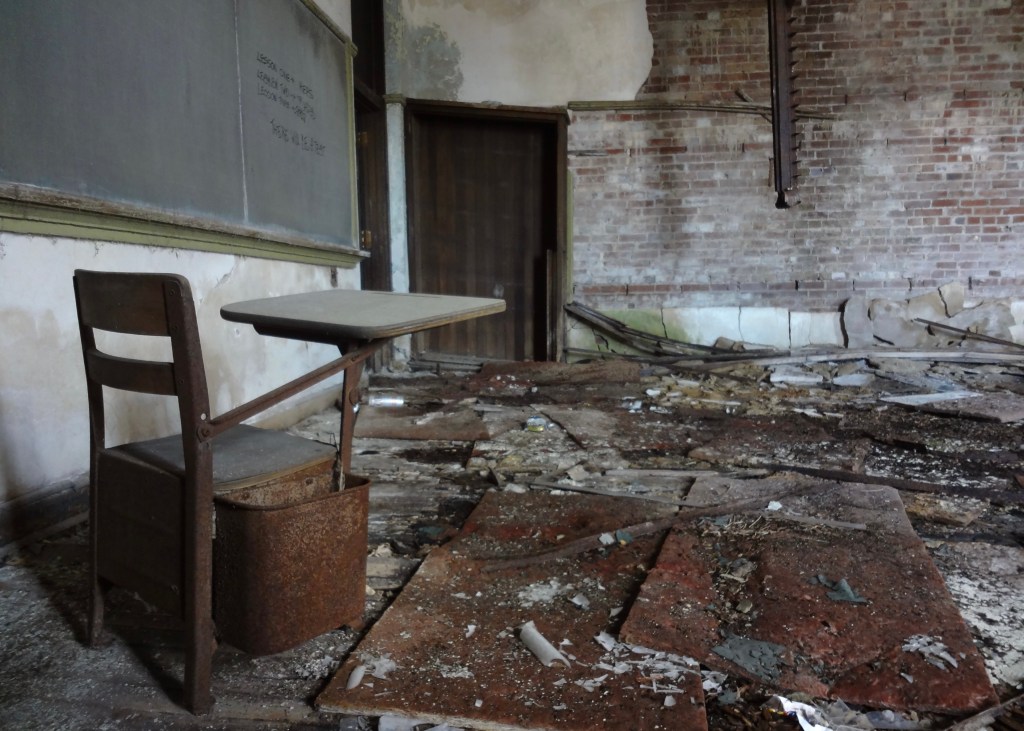
But my attention was even more powerfully drawn to the middle of the room. There, in pride of place, was an actual, and quite antique, school desk. Ornate and dignified, it sat alone, lit by the window, facing the chalkboard: a single desk for a one-child schoolhouse.
I tried to imagine the room in use. Did the mother summon her son to class with a bell? Did she call him to the board to solve a math problem? Was there a ten-minute recess and a thirty-minute lunch? Did he raise his hand to go to the bathroom? Surely not. Nor was any of this required by the state of Maryland. Unlike their farming and baking, homeschooling did not require industrial equipment. It was also obvious that this was not a decorating conceit. While their home was spotless, it was pragmatically furnished. Their lives left little room for whimsey.
Yet here it was: a schoolhouse where none was needed. What, then, did it all mean?
-0-
“For religious man,” wrote the philosopher Mircea Eliade, “space is not homogeneous; he experiences interruptions, breaks in it; some parts of space are qualitatively different from others.” He is arguing that within the material world—the world of the profane—there are places endowed with greater meaning and significance, which we call “sacred.” These spaces provide for the faithful a point of orientation; within some societies they are viewed as the “center of the world.”
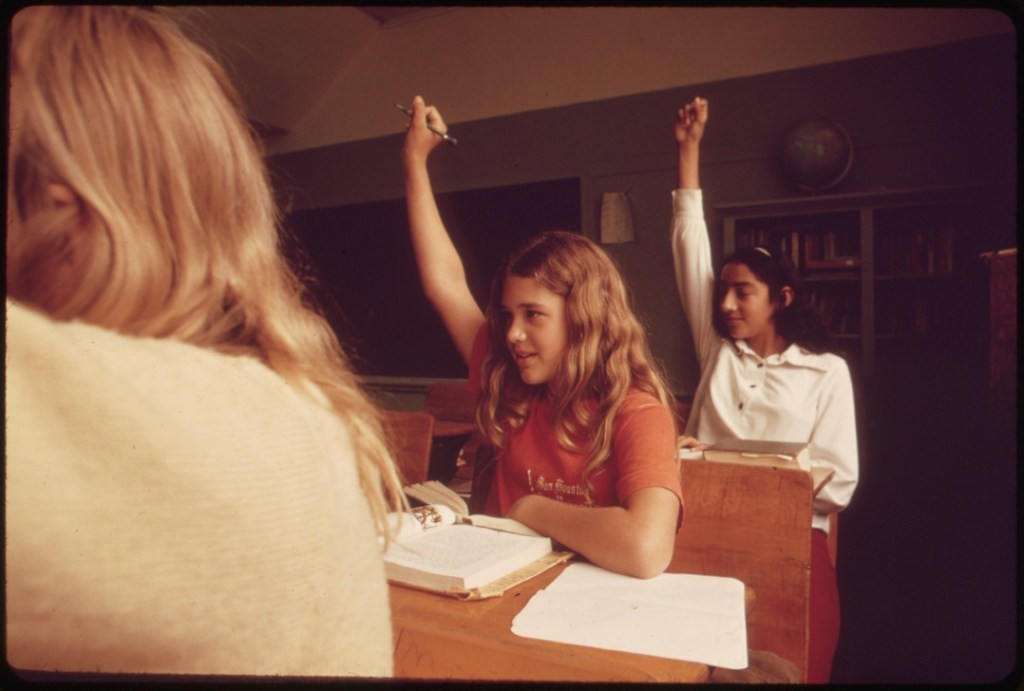
Churches, mosques, and synagogues are all sacred spaces. But so are schools. They, too, provide a point of orientation. And just as religion regulates and systematizes faith, so schools shape all the things we call education. The recognizable outline of the American schoolhouse and the familiar patterns of academic life—what education historians David Tyack and Larry Cuban call the “grammar of schooling”—give physical form to our beliefs and values.
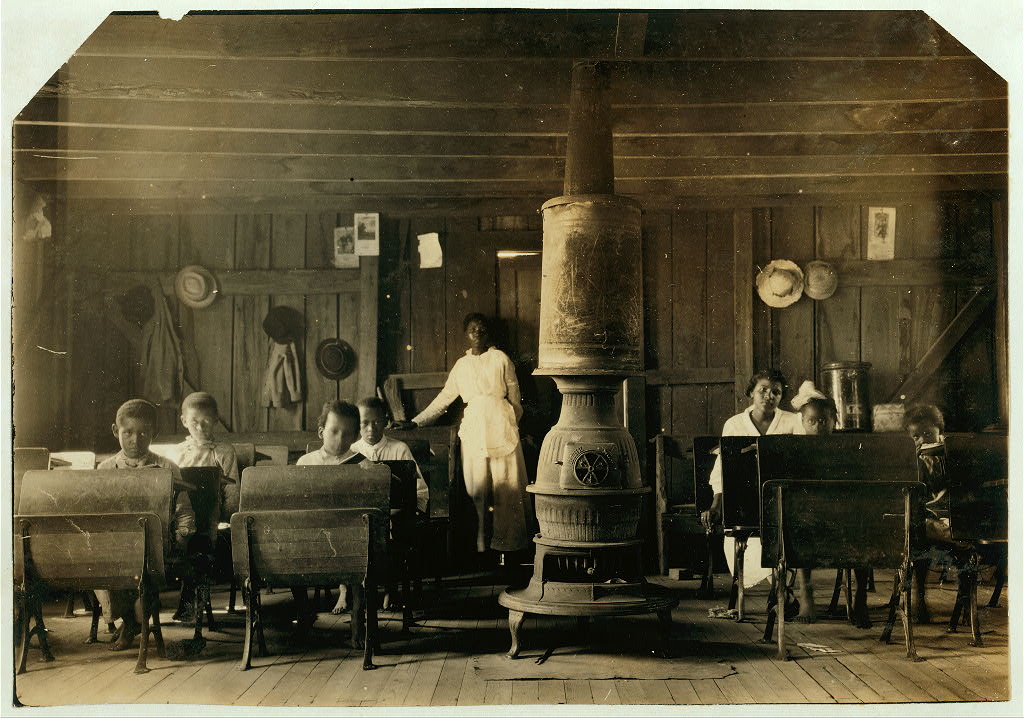
Because the grammar of schooling shapes the very structure of our thoughts, it is stubbornly resistant to change. The organization of students into classes, the arrangement of instruction by subject, the orchestrated movement from one grade to the next is largely the same today as was a generation ago, and generations before that. The proverbial one room schoolhouse of an earlier century is, in all the important ways, identical to the suburban elementary school classroom of today.
This continuity is a source of comfort. Even when we don’t know what it means to be educated, we all know what it means to be schooled. Schools validate—sanctify—all that we do in the name of education. Education becomes the things that schools do.
But by capturing our imaginations and, in some ways, holding us hostage, these institutions also limit our vision. There are over 115,000 k-12 schools in the United States, and nearly 4,000 colleges and universities. This is a point of pride, but the light they shine has cast the rest of the world in darkness. Beyond the schoolhouse and university campus we perceive a world of chaos. If school represents learning, everything else becomes fallow ground: the world of the profane.
But if we shield our eyes and peer more closely, it is not difficult to perceive that learning is embedded within the fabric of our daily lives. Beyond classrooms, the life of the mind is also sustained within libraries, concert halls, museums, galleries—and many other places besides: on subways, with a book; in cafes, with a friend; on a mountain trail, in search of a moment of wonder. What is all this, if not the active work of learning? Humans are a species lost in thought, in constant pursuit of knowledge and, in our better moments, wisdom.
“We learn first as students,” Anthony Grafton writes in Worlds Made by Words: Scholarship and Community in the Modern West, “and then as practitioners of disciplines, members of communities, users of libraries, habitués of archives, apprentices, and friends—as lurkers in particular intellectual, social, and institutional corners from which we look at the wide world.”
It lives in these settings because it is sustained, not by institutions, but by people themselves. “Learning, knowing, studying, and contemplating are activities that live and breathe in individual human beings,” Zina Hitz argues in Lost in Thought: The Hidden Pleasures of an Intellectual Life. It begins, she proposes, not on the first day of school, nor does it end after the last day of college. Instead, it is born and sustained “in the inward thoughts of children and adults, in the quiet life of bookworms, in the secret glances at the morning sky on they way to work, or the casual study of birds from the deck chair.”
More than Grafton, Hitz sees the life of the mind as fundamentally private, even secret. “The hidden life of learning is its core, what matters about it,” she argues. My perspective—the one that will guide this project—is that the life of the mind is a dynamic interaction of the private and the public. I agree with Hitz that it is, first, an upwelling of the inward spirit. It is what we do for ourselves, and often by ourselves. I also believe that communities and nations can either nurture or inhibit intellectual life. Scholarship will always exist, but if valued as a public good, it can more comfortably thrive as a private pleasure.
And this is why it is so important that, as a first step, we open our eyes to the to fundamental fact that learning does not depend on schoolhouses or the holy relics of education. “Therefore is the mind too strait to contain itself,” Augustine marveled in his Confessions. So, too, our schools are too narrow to hold all that we know. We must look outward to see the fullness of the mind. To do this, we need the wisdom and generosity of heart to recognize scholars wherever they can be found. We need the courage to see ourselves as scholars, no matter our present circumstances. We need to see the contemplative spirit, not as an enterprise of a select few, but as the birthright of all.
Those of us who come from academe need to fight the tendency, whether born out of love or pride, to see our institutions as strongholds of the intellect. We are not soldiers defending the ramparts against barbarians. Nor are we monks who sustain civilization after the fall of Rome. We are only people among many people who are asking questions and eager to find meaningful answers. Those who do this with rigor and honesty represent the true community of scholars.
To understand this, we all need to get out of our school desks and put down the chalk.
-0-
For nearly two thousand years, the Christian church held tremendous power over the Western world. A person living outside the church was a person who was outside society and beyond redemption. This power—to the great consternation of a few—has all but evaporated. We are now living in what some call a post-religious age. Fewer and fewer people go to church or even profess a denominational affiliation.
Yet the decline of organized religion does not mean the end of faith. Indeed, there is strong evidence that as religion declines, the desire for a spiritual life grows. There is, as one study phrased it, “a shift from institutionally fixed forms of dogmatic religion to individually flexible forms of spiritual religion.”
In a sense, Western society is rediscovering what it has forgotten: that the sacred exists everywhere. This is what Eliade was ultimately saying. Faith does not reside only within churches and temples. Mountains, rivers, forests: all can be imbued with the sacred. Transcendence can be encountered in the most unexpected places and times: Under a canopy of stars on summer night, or in a barren Old Testament desert: “Put off thy shoes from off thy feel, for the place whereon thou standest is holy ground.”
But in this newfound climate of spiritual openness, we have yet to experience a parallel revolution in education. We have yet to embrace the sacred places of learning. We hold tight to the belief that the gods of wisdom are found exclusively in our temples of scholarship, and can be summoned only through the rituals of academic life. Beyond its gates, we still see only darkness—the unformed chaos of the profane.
Yet it is in the untamed wilderness of intellectual life that we can discern the true power and importance of learning. It cannot be controlled, or denied. It is a force of nature. What would happen if we stretch out our hands in wonder and say, “This, too, is holy ground?”
-0-
Our day with the Mennonites ended with lunch. Continuing our conversation, the mother offered a confession: The school room we just saw was, in fact, rarely used. As it turned out, she believed in “learning by doing.” At the moment, her son was helping his father with some roofing. “It’s very educational,” she said.
I nodded, of course, to be polite, because what struck me most in that moment was the defiant tone of her voice. She was revealing a secret, perhaps even confiding a heresy. She believed that education was more than seat time and assessments. But what it was, exactly, was not entirely clear, and perhaps not safe to discuss. After all, what would I think, knowing that her school was empty, that her church no longer held a congregation?
Bibliography
Augustine. The Confessions of Saint Augustine. https://www.gutenberg.org/cache/epub/3296/pg3296-images.html
Eliade, Mircea. The Sacred and the Profane: The Nature of Religion. New York: Harcourt, 1987.
Grafton, Anthony. Worlds Made by Words: Scholarship and Community in the Modern West. Cambridge, Mass: Harvard University Press, 2011.
Hedlund-de Witt, Annick. “The Rising Culture and Worldview of Contemporary Spirituality: A Sociological Study of Potentials and Pitfalls for Sustainable Development.” Ecological Economics 70, no 6 (2011): 1057-1065. https://www.sciencedirect.com/science/article/abs/pii/S0921800911000486
Hitz, Zina. Lost in Thought: The Hidden Pleasures of an Intellectual Life. Princeton: Princeton University Press, 2020.
Tyack, David, and Larry Cuban: Tinkering Toward Utopia: A Century of Public School Reform. Cambridge, Mass: Harvard University Press, 1995.
 Perpetual Student