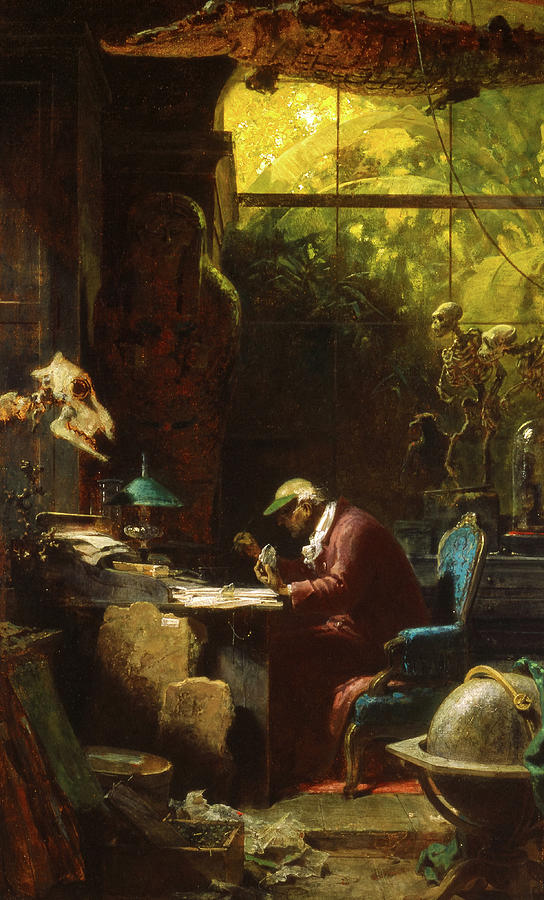
The subject of Carl Spitzweg’s painting, The Scholar of Natural Resources, is a gentleman of means. He is well dressed; his paneled study is large and well appointed. He sits in an upholstered chair, which rests on an oriental rug thrown over a stone floor. Light streams through large mullioned windows. Deeply absorbed in his labors, he contemplates a small object—an artifact of some kind—held in his left hand.
Leaning over a desk, his face shadowed by a bookkeeper’s visor, the scholar is oblivious of his surroundings, but we are not. The room is a distracting cabinet of curiosities. A stuffed alligator hangs convivially from the ceiling; hominid skeletons strike lifelike poses by the window; the skull of something like a moose pokes intrusively from the picture frame’s left edge; stone tablets, in dusty neglect, lean against the desk; an Egyptian mummy stands against the wall, nearly lost in shadow.
The artifacts crowd around the scholar, competing for the viewer’s attention. Some—the moose skull, especially, which might be smiling—appears more animated than the putative subject of the painting, who remains frozen in an aspect of deep concentration, nearly lost amid his collection.
The setting is eccentric, made stranger still by the lush tropical foliage pressing hard against the window panes. Enormous palm fronds are illuminated by a warm equatorial sun, even as the scholar, encased in his gothic surroundings, feels the need for a warm coat. Where are we, really?
-0-
Spitzweg was a self-taught German artist active from the mid to late nineteenth century, known for genre paintings of small town life. But he is best remembered for amusing portraits of artists and intellectuals caught in the act of being slightly absurd. His most famous painting, The Poor Poet depicts a man so deeply absorbed in the work of composition that he fails to grasp the squalor of his surroundings.
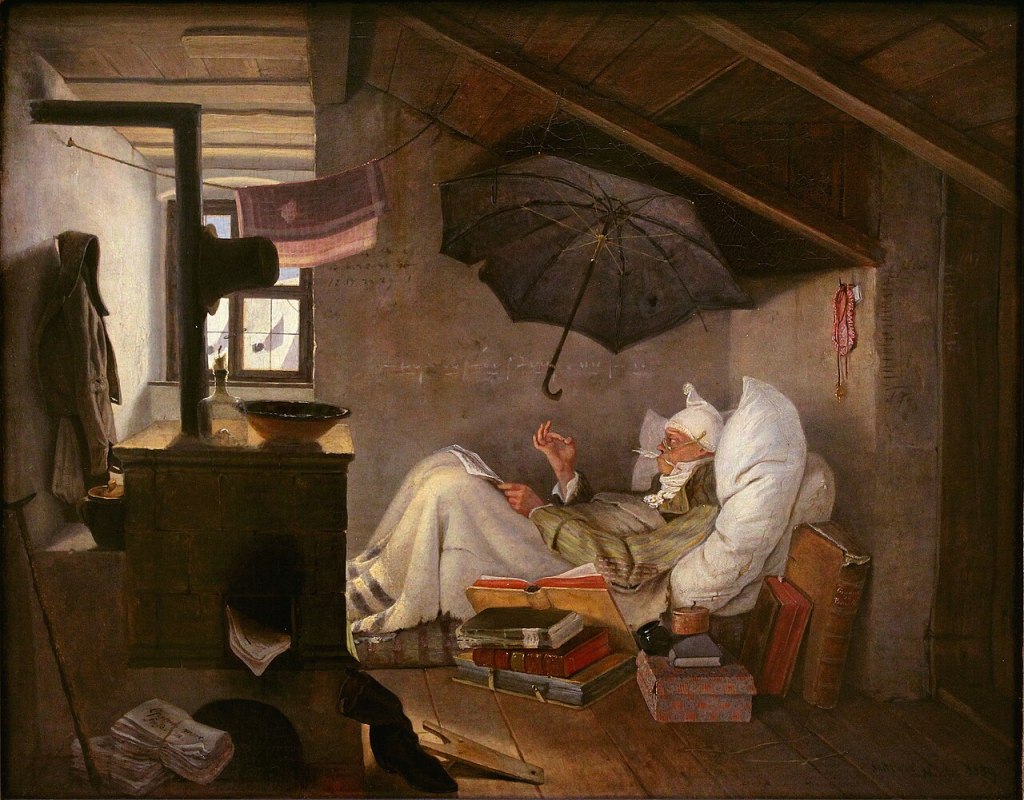
But while we are encouraged to laugh, we do so gently, with affection, because it is clear that we are spying on someone who is caught up in a noble quest: to pursue knowledge, to create art, to experience beauty. We are not in the presence of genius—and that’s the joke— but we are in the presence of a pure and burning passion, which is no less precious.
Stylistically, The Scholar of Natural Resources is one of Spitzweg’s strongest, but thematically it is one of his strangest. The Milwaukee Art Museum, which holds the painting, offers a remarkably literal analysis, proposing that Spitzweg is paying homage to the “different areas of scientific inquiry.” The alligator represents zoology; the mummy, Egyptology; the plants, botany. And so on.
This misses the point. The setting is otherworldly because we are not in the world. We are in the scholar’s mind. We are seeing the physical manifestation of his thoughts—the churning of his imagination as he ponders the object in his hand, searching for meaning as all the disparate pieces of his experience swirl around him. It is a crowded, chaotic place, but also rich and fertile—more real, more wonderful, than the cobwebbed and chilly study where his body resides.
I don’t know if this was, in fact, Spitzweg’s intention. But, purposefully or accidentally, this minor master of the Biedermeier style found a way to powerfully capture the mind on fire—the way ideas become real and urgent and beautiful as the fragments of a messy and confusing world join together, if only briefly, into a moment of transcendent understanding and awe.
It is this feeling, this intangible quality of the scholarly life, that I wish to explore in the coming days. I begin with The Scholar of Natural Resources because it captures the motivating spirit of the project, the conviction that the life of the mind is a rich and compelling world.
-0-
There is much talk now about the diminishing respect for scholarship, and scholars. The United States—so obsessed with material wealth and power—has, we are often told, no interest in the intellectual life, which is mocked as unremunerative and effete. What’s the point of studying philosophy, or art history, or English literature. Where’s the ROI?
I agree that scholarship is threatened now more than ever before. Universities are under attack; education is valued by many only for the credentials it provides. We are bombarded with forms of social media distraction unimaginable even a few years ago. With AI we can even outsource our thinking, and do so willingly.
But in this fraught and anxious time, this project takes a different tack. Rather than focusing on the feared decline of intellectual life, it looks at how it is sustained. Defining “scholarship” broadly, it explores how the life of the mind is pursued, why it matters to so many, and where it still exists—not only in academe, but also (and especially) in unexpected and overlooked places, both public and private.
It views the life of the mind not as an eccentricity, the pastime of a few, or the domain of the elite, but as something accessible to all, and practiced in many ways by many different people. It argues that scholarship is not a finite resource, but a universally practiced human activity that, while denigrated by some, is more robust than we imagine.
Of course, I hope that by celebrating the life of the mind and making its many forms of expression more visible, we will find ways to make it a larger part of civic life. But I’m not going to fall into the trap of arguing that the pursuit of knowledge is good for us or—as partisans of the liberal arts try to argue—“practical.” It’s true that those who graduate with liberal arts degrees are better off than critics assert, but what this project argues is that those who engage in scholarly pursuits don’t really care about their practical benefits. They don’t follow their various, often esoteric interests because they expect to become richer, stronger, healthier, or more popular. They do it because they want to, because it makes the world comprehensible, because it makes life feel richer and more purposeful. They do it knowing, but not caring, that they might look like a character in a Carl Spitzweg painting.
That’s a story rarely told. But it’s the only one that counts.
 Perpetual Student